f-stop Tilopa Review: Our Honest Long-Term Experience After Almost Four Years of Use
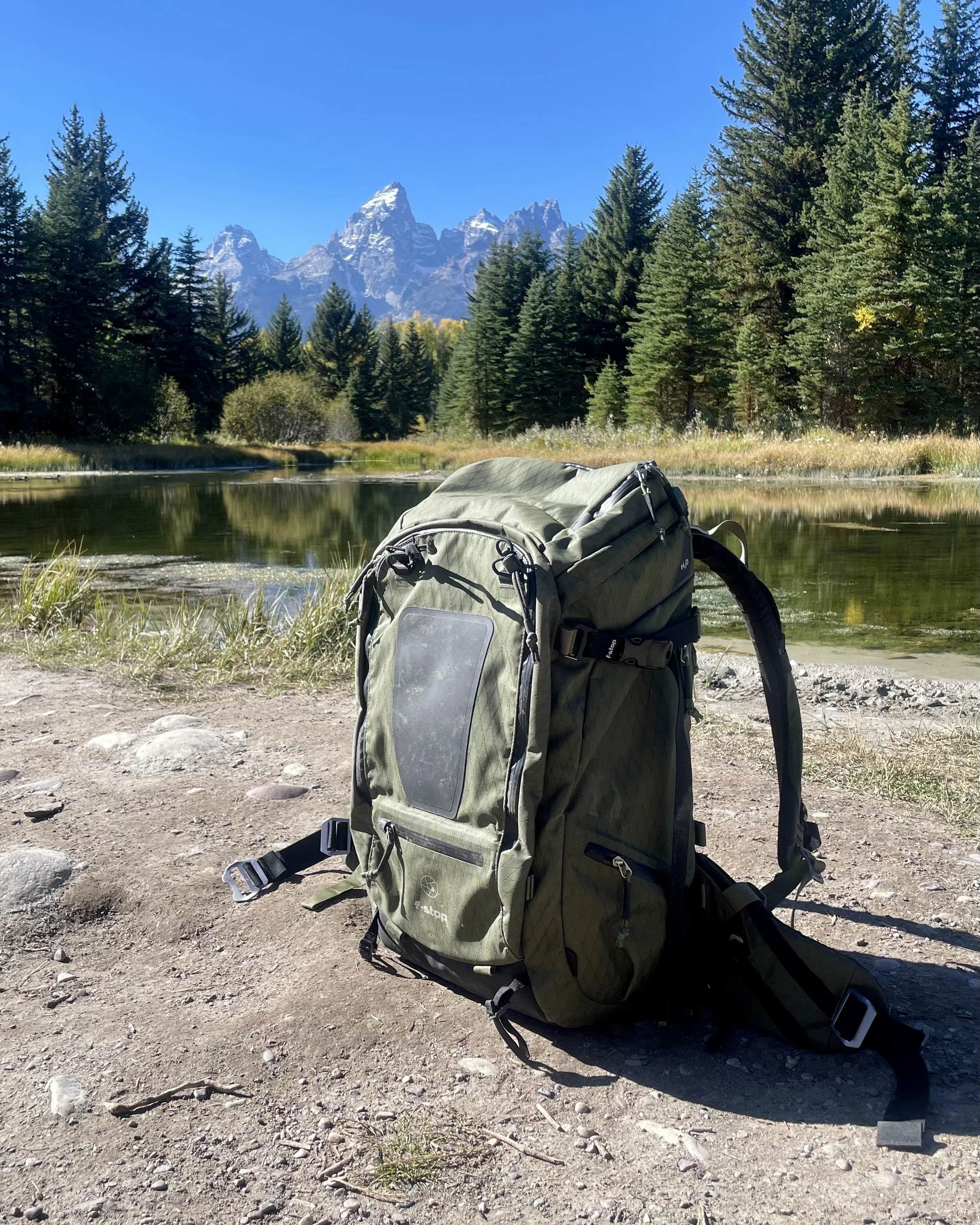
Tilopa with us on a trip to Grand Teton NP in USA.
Choosing the right camera bag is a bit like choosing the right pair of hiking boots. It has to fit your body, your gear, your way of working — and it has to keep performing when conditions are far from ideal. One size definitely does not fit all.
Over the years, we have tested more camera bags than we care to admit. We have used dedicated camera backpacks, outdoor packs adapted for camera gear, and, in desperate situations, the occasional regular backpack filled with lenses, jackets and a healthy dose of optimism. Some bags have come close to perfect, but we have often felt there was room for improvement.
A camera bag is one of those pieces of equipment that does not directly take the picture, but it can absolutely decide whether you get the picture. If your gear is difficult to access, poorly protected, uncomfortable to carry, or badly organised, it will slow you down. And in wildlife and landscape photography, that can be the difference between getting the shot and watching the moment disappear.
That is why we were genuinely interested when we started using f-stop. And yes, before anyone says it: we are f-stop ambassadors. But we are also extremely picky about the brands we collaborate with. For us, a camera bag is not just a logo on your back. It is a tool that has to protect expensive gear, work in the field, stay comfortable for long days, and make photography easier — not more complicated.
So this is not a blind praise piece. This is our honest, long-term review of the f-stop Tilopa — quirks included.
Why a Good Camera Bag Matters
A proper camera bag is one of those things you may not fully appreciate until you use the wrong one.
Imagine hiking up a mountain with your lenses knocking around in an ordinary backpack, your camera buried under a rain jacket, and your tripod hanging awkwardly from whatever strap you could find. Not ideal. A good camera bag protects your gear, keeps everything organised, gives you fast access when the moment happens, and saves your back during long days in the field.
For wildlife and landscape photography, this matters even more. The perfect moment rarely waits while you dig through your bag like a stressed squirrel looking for a missing lens cap.
A good camera bag also needs to do more than carry camera equipment. It has to carry the things that keep you functioning as a photographer: extra layers, gloves, food, water, filters, batteries, rain protection, a headlamp, maybe a drone, and sometimes enough random outdoor gear to make you question your life choices halfway up a mountain.
That balance — camera gear versus everything else — is where many bags struggle. Some are great camera bags but poor outdoor backpacks. Others are comfortable hiking bags but awkward for photography. The Tilopa sits somewhere in the middle, and that is a big part of why it has worked so well for us.
The f-stop Tilopa: Built for Serious Use
The f-stop Tilopa has become the crown jewel in our collection of camera bags. With its 50-litre capacity, it is not a small backpack — and it does not try to be. This is a proper expedition-style camera bag designed for photographers who need to carry a serious amount of gear into the field.
The construction feels rugged and confidence-inspiring. After almost four years of use, it still feels like a bag made for real outdoor work: mountains, snow, rain, mud, airports, boats, hides and long hikes. It has the kind of build quality where you do not feel the need to baby it — which is exactly what we want from a camera backpack.
We have used it in conditions where gear gets wet, frozen, dirty, thrown into cars, placed on rough ground and carried for hours. A bag like this needs to tolerate abuse without making you nervous, and the Tilopa does that very well.
It is not a delicate city backpack. It is not trying to look like something you would take to a café with a laptop and one small camera body. It is an outdoor photography backpack first and foremost. That is important to understand, because if you buy it for the wrong use case, it may feel too large and too technical. But if you buy it for the right use case, it makes a lot of sense.
We chose the green version, partly because it fits well into natural surroundings and partly because, let’s be honest, it looks good. If you photograph wildlife, being a little less visible in the landscape is not a bad thing. We are not saying the bag turns you invisible, but every little bit helps when you are trying not to look like a walking camera store in the middle of nature.
Space and Organisation
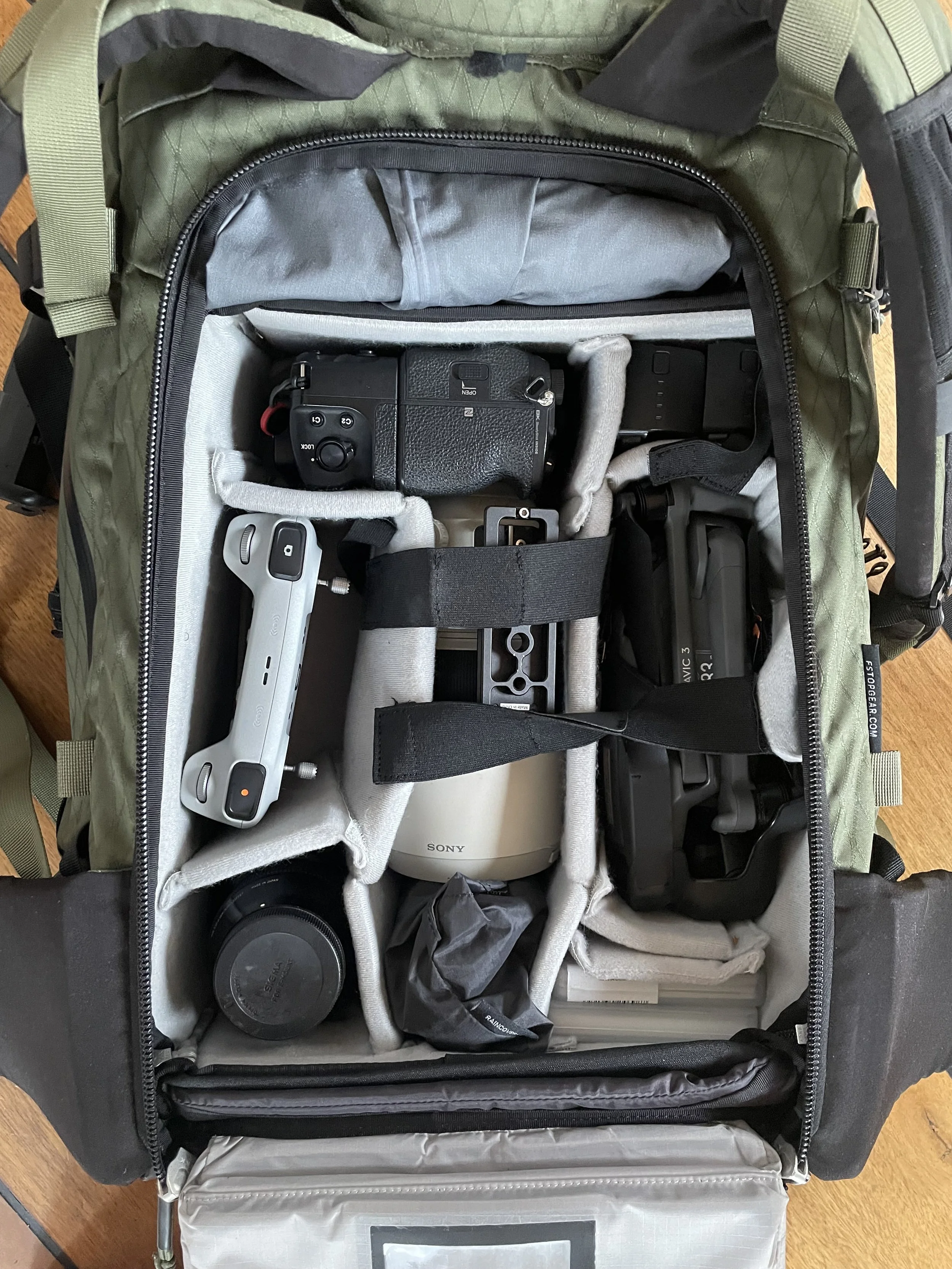
A normally packed back, when we are out taking landscape pictures
The Tilopa uses f-stop’s Internal Camera Unit system, better known as ICUs. This is one of the main reasons the bag works so well. Instead of locking you into one fixed layout, the ICU system lets you choose how much of the bag you want to dedicate to camera gear and how much you want to leave for clothing, food and other essentials.
This modular approach is, in our opinion, one of f-stop’s biggest strengths. Photography trips are not always the same. Some days you need to carry a lot of camera gear. Other days you need more space for extra clothing, food, safety equipment or travel essentials. With the ICU system, the bag can be adapted instead of forcing you into one fixed setup.
We normally use either the ICU Pro Large or the ICU Pro XL.
With the ICU Pro Large, there is still a good amount of room left for extra layers, snacks, gloves, a small jacket and other things you typically need during a long day outside. This setup feels like a very good balance between camera equipment and general outdoor use. For many trips, this is probably the most practical configuration.
With the ICU Pro XL, you get more space for gear, but less room for everything else. That setup makes sense when photography equipment is the priority and you are willing to sacrifice some non-camera storage. It is the better choice when you want to carry multiple bodies, several lenses and accessories, but it does turn the Tilopa into more of a pure camera-hauling machine.
The ICU is secured inside the bag with four small Velcro straps, positioned close to your back. It feels stable and well-integrated, and it keeps the gear from shifting around while you move. Access is easy and logical, and once you have arranged the dividers to fit your kit, the system works extremely well.
The rear access is also something we have come to appreciate. When you place the bag down, the part that touches your back does not end up directly in the mud, snow or wet ground. It also gives you a good overview of your camera gear when the bag is open. For us, that is much more practical than digging down from the top and hoping the lens you need is somewhere near the surface.
That said, even the ICU Pro XL can be a bit tight if you want to carry a large 400mm or 600mm prime lens with a camera body attached. It is possible to pack big gear, but if you regularly carry large super-telephoto primes fully assembled, you may need to think carefully about your setup — or look at something larger, such as the f-stop Shinn.
In other words: the Tilopa is spacious, but it is not magic. A 50-litre bag is still a 50-litre bag, and big wildlife lenses are big wildlife lenses.
Comfort and Carrying System
Comfort is one of the Tilopa’s strongest points. The shoulder straps and hip belt are well padded, supportive and clearly made for carrying weight over distance. When the bag is fully loaded, that matters a lot.
The Tilopa also has an integrated carrying/support system that can be removed. That is a useful feature if you want to reduce weight, change how the bag feels, or adapt it for different types of use. We like that flexibility, because not every trip requires the same setup.
When you load a backpack with camera bodies, lenses, batteries, filters, tripod, food, clothing and water, the weight adds up fast. This is where the Tilopa feels more like a serious outdoor pack than a typical camera backpack. The hip belt actually does its job, and the weight can be transferred properly instead of hanging entirely from your shoulders.
For Henrik, who is tall, the Tilopa fits extremely well. It sits properly on the back, transfers weight effectively to the hips, and feels like a serious outdoor backpack rather than just a camera bag pretending to be one.
For Kirsten, who is smaller, the Tilopa can feel big. Not unusable, but definitely more like carrying a small mountain. For her, the smaller f-stop Ajna is often a better fit.
There is one interesting comparison between the Tilopa and the Ajna. The Tilopa has more padding and feels more substantial, which is great when carrying heavy loads. But the slimmer feel of the Ajna can actually be preferable in some situations. The Tilopa is very comfortable, but we still think there is room for refinement in how the padding and harness feel on different body types.
So, is the fit like carrying a cloud or a mountain? For Henrik, more cloud. For Kirsten, sometimes mountain.
This is probably one of the most important points in the whole review: the Tilopa is an excellent bag, but it is not the right size for everyone. If you are shorter or prefer a more compact setup, you should definitely try it on before deciding. A camera bag can be technically brilliant and still be wrong for your body.
The Metal Buckles: Love and Hate
One feature we have a genuine love/hate relationship with is the metal buckles around the waist belt.
On the positive side, they are extremely durable. We have broken more plastic buckles than we care to remember — by stepping on them, closing them in doors, or generally treating bags the way outdoor photographers tend to treat bags. The metal buckles feel almost indestructible.
The downside is noise. They can clank. And if you are trying to approach wildlife quietly or sit unnoticed in a hide, that is not ideal. It is not a dealbreaker, but it is something worth knowing.
For landscape photography, this is rarely a problem. Mountains do not usually care if your waist buckle makes a small metallic sound. Wildlife, however, might. If you photograph birds, mammals or other nervous subjects, small noises can matter.
The solution is not complicated — you can handle the buckles carefully and reduce the noise — but we would still love to see an even quieter version in the future.
Hydration System
The Tilopa has space for a hydration bladder, such as a CamelBak-style system. In theory, that is great. In practice, we are a little cautious.
We would prefer a completely separate compartment for water. Carrying a liquid bladder close to expensive camera gear always makes us slightly nervous. Water and electronics have never been the best of friends, and although the system works, this is one area where we would like to see an even cleaner separation.
For many people, this may not be a big concern. Plenty of outdoor photographers use hydration systems without issues. But when you are carrying expensive camera bodies and lenses, even a small risk of leakage is something you think about.
Personally, we often prefer bottles or other water solutions that feel more separated from the camera gear. That may be a little paranoid, but camera gear is expensive enough to justify a bit of paranoia.
Tripod Carrying
The tripod solution is functional, but not our favourite part of the bag.
Instead of a large dedicated side pocket, the Tilopa uses a smaller zippered pocket that opens to support the foot of the tripod. It works, and we have used it many times, but we are not completely sold on the design. For some tripod setups, a more traditional side pocket would feel more secure and convenient.
This is not a major flaw, but it is one of those practical details you notice after years of real-world use. If you carry a lightweight travel tripod, the system is fine. If you carry a larger, heavier tripod for serious landscape or wildlife work, the setup can feel less elegant than the rest of the bag.
The Tilopa can absolutely carry a tripod. We just think this part of the design could be improved.
Access in the Field
One of the things we appreciate most after almost four years of use is how well the Tilopa works when you stop, put the bag down and need access to your gear.
The rear panel opens up to the ICU, giving you a clear view of your equipment. That sounds simple, but in the field it makes a big difference. You can quickly see what is where, change lenses, grab filters, swap batteries or reorganise without emptying half the bag.
This is especially useful when conditions are cold, wet or windy. The less time you spend searching, the better. Gloves, rain, snow and stress do not make anyone better at finding small accessories.
The Tilopa is not the fastest sling-style bag for instant camera access while walking. That is not what it is designed for. But for serious field work where you carry a larger setup and stop to shoot, the access works very well.
What We Usually Carry
The exact setup changes depending on the trip, but the Tilopa typically allows us to carry a very serious camera kit.
Depending on the ICU configuration, we can carry camera bodies, several lenses, batteries, memory cards, filters, cleaning gear and accessories, while still leaving some space for non-camera essentials. With the ICU Pro Large, the bag feels more balanced for mixed outdoor use. With the ICU Pro XL, it becomes more dedicated to gear-heavy photography days.
That flexibility is probably one of the reasons we keep using it. The bag can be configured for wildlife, landscape, travel or more general outdoor photography without feeling like we need a completely different backpack for every situation.
There are limits, of course. If you are carrying very large prime lenses, multiple bodies and a lot of extra outdoor gear, you can fill the Tilopa quickly. But for most serious photographers, it offers a strong combination of capacity and practicality.
Durability After Almost Four Years
After almost four years of use, the Tilopa has proven itself. That is probably the strongest compliment we can give it.
A lot of bags feel impressive when they are new. The real test is what happens after years of travel, outdoor use and repeated packing and unpacking. Zippers, straps, buckles, fabric, stitching and padding all start to reveal whether the bag was genuinely built for heavy use.
The Tilopa still feels solid. It has been used hard, and it has remained reliable. That matters to us much more than a perfectly polished first impression.
A camera bag does not need to look brand new forever. In fact, we like bags that show a bit of use. But it does need to remain functional, protective and comfortable. The Tilopa has done that.
Price and Value
The Tilopa is not cheap. And once you add an ICU, the total price climbs quickly.
That is worth being very honest about. This is an investment, not an impulse buy. If you only occasionally carry a small camera setup, it may be more bag than you need.
But after using it for almost four years, we can say that it has been worth it for us. It is the most-used camera bag we own, and it has handled everything from travel to long days in the field. The build quality, flexibility and comfort make it a bag we keep coming back to.
Value is not only about the purchase price. It is also about how often you use something, how well it performs, and whether you trust it when conditions are difficult. By that measure, the Tilopa has been very good value for us.
Who Is the Tilopa For?
The Tilopa is best suited for photographers who need to carry a substantial amount of gear and who spend time outdoors. Landscape photographers, wildlife photographers, adventure photographers and travelling photographers with larger kits are probably the most obvious users.
It is especially relevant if you want one bag that can handle both camera gear and outdoor essentials. The modular ICU system makes it possible to adjust the balance depending on the trip.
It is less ideal if you mainly shoot in cities, travel very light, or want something sleek and discreet for everyday use. In those cases, the Tilopa may feel too large, too technical and too outdoor-focused.
It is also worth considering body size. Taller photographers may find the Tilopa extremely comfortable. Smaller photographers may prefer the Ajna or another more compact f-stop bag.
What We Would Improve
After almost four years of use, our main criticisms are quite specific.
We would like the metal buckles to be quieter. We love the durability, but not the clanking.
We would prefer a more separated hydration compartment. The current system works, but water next to camera gear will always make us a little nervous.
We would like a more convincing tripod carrying solution, especially for larger tripods.
And finally, we think the harness and padding are excellent for carrying weight, but the fit could be more adaptable for smaller photographers.
None of these points ruin the bag for us. But they are the things we would improve if we were designing the next version.
Final Verdict
The f-stop Tilopa is rugged, spacious, flexible and genuinely built for photographers who spend time outdoors. It is not perfect. The metal buckles can be noisy, the hydration setup could be better separated, the tripod solution is not our favourite, and the fit will suit taller photographers better than smaller ones.
But despite those points, it has become our most trusted and most-used camera backpack.
For us, that says more than any spec sheet ever could.
After almost four years of use, the Tilopa has earned its place as one of the most important pieces of gear we own. Not because it is flashy, but because it works. It protects our equipment, carries a serious load, adapts to different trips and keeps coming back for more.
If you are ready to invest in a camera bag that can handle serious adventures, carry a substantial amount of gear, and still remain comfortable on long days outside, the f-stop Tilopa might be exactly what you are looking for.
It is not the right bag for everyone. But for the right photographer, it is a very, very good one.